
BMI Result
Use our free BMI Calculator to quickly calculate your Body Mass Index (BMI) using your height and weight. You can choose metric units (kg and cm) or imperial units (lb, ft, and in) to get your BMI, weight category, and healthy weight range.
BMI is a simple measure of weight relative to height. For adults, it is usually used as a screening tool to help in finding whether a person’s weight falls within the underweight, healthy weight, overweight, or obesity range. BMI does not diagnose health conditions and should be considered together with other health factors.
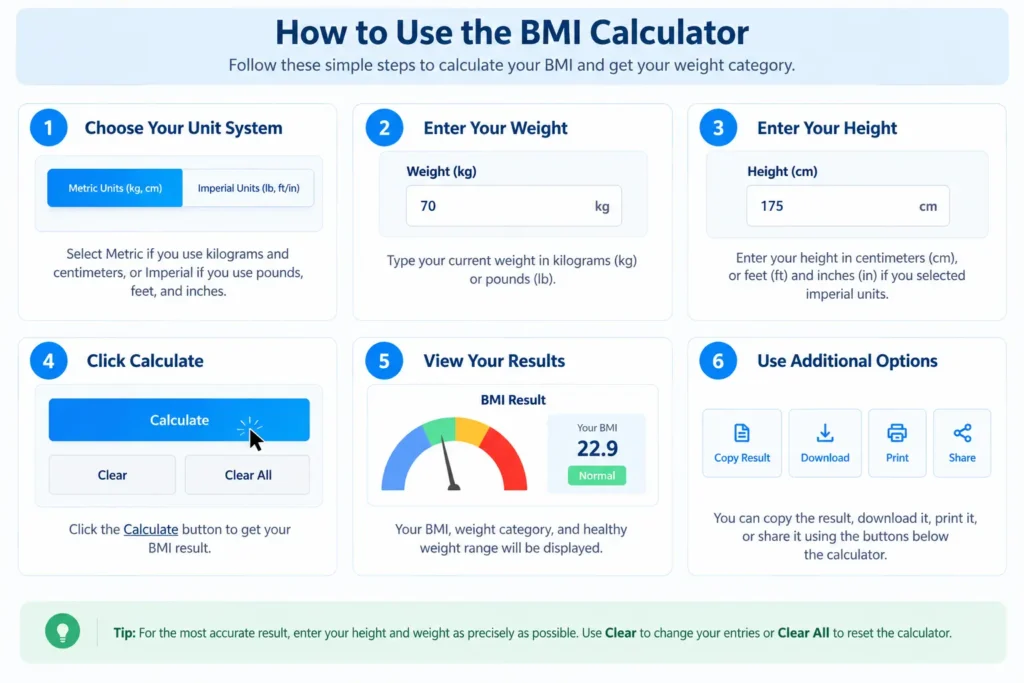
How to Use the BMI Calculator
The BMI Calculator makes it easy to check your BMI. You can use either metric or imperial measurements.
1. Choose your unit system
Select Metric if you use kilograms and centimeters, or click on Imperial if you use pounds, feet, and inches.
2. Enter your weight
Enter your current weight in kilograms (kg) or pounds (lb) depends on which option you selected.
3. Enter your height
Enter your height in centimeters (cm) for metric measurements, or feet (ft) and inches (in) for imperial measurements.
4. Then select Calculate.
The calculator will quickly calculate your BMI and show your weight category.
5. Review your results.
You can also see the healthy weight range for your entered height.
For the most useful result, enter your height and weight as accurately as possible. You can use Clear button to change your entries and calculate again.
What Is BMI?
BMI, or Body Mass Index, is a measure that compares your weight with your height. It provides a simple numerical value that can be used to place an adult’s weight into one of four general categories: underweight, healthy weight, overweight, or obesity.
For adults aged 20 and older, the standard BMI categories are used regardless of age or sex.
BMI is useful as a quick screening measure, but it does not directly measure body fat. It also cannot distinguish between fat, muscle, and bone mass. For this reason, your BMI should be considered alongside other information when assessing your overall health.
How to Calculate BMI
BMI is calculated by dividing your weight by your height squared. The exact formula depends on the measurement units you are using.
BMI Formula Using Kilograms and Meters
If your weight is in kilograms and your height is in meters, use this formula:
BMI = weight (kg) ÷ height² (m²)
For example, a person whose weight is 70 kg and is 1.75 m tall would calculate BMI as:
BMI = 70 ÷ (1.75 × 1.75) = 22.9
The resulting BMI is approximately 22.9.
BMI Formula Using Kilograms and Centimeters
If you measure your height in centimeters, you do not need to convert it manually to meters. You can use:
BMI = [weight (kg) ÷ height (cm) ÷ height (cm)] × 10,000
For a person weighing 70 kg with a height of 175 cm:
BMI = (70 ÷ 175 ÷ 175) × 10,000 = 22.9
This produces the same BMI as the meters-based formula.
BMI Formula Using Pounds and Inches
if you are using imperial measurements, first convert your full height into inches. Then use:
BMI = [weight (lb) ÷ height² (in²)] × 703
For example, someone whose weight is 154 lb and is 5 ft 9 in tall is 69 inches tall.
BMI = [154 ÷ (69 × 69)] × 703 = 22.7
The calculated BMI is approximately 22.7.
You can avoid doing these calculations manually by entering your height and weight into the BMI Calculator above.
BMI Calculation Examples
The examples below show how different combinations of height and weight produce different BMI results.
| Height | Weight | BMI | Weight Category |
|---|---|---|---|
| 160 cm | 45 kg | 17.6 | Underweight |
| 175 cm | 70 kg | 22.9 | Healthy weight |
| 180 cm | 85 kg | 26.2 | Overweight |
| 170 cm | 90 kg | 31.1 | Obesity |
For example, a person who is 175 cm tall and has a weight of 70 kg has a BMI of approximately 22.9, which is considered within the healthy weight range for adults.
These examples are for adults aged 20 and older. BMI for children and teens is interpreted differently using age- and sex-specific percentiles.
BMI Chart for Adults
The BMI chart below shows the standard weight categories for adults aged 20 and older. You can compare your BMI result with these ranges to see which category it falls into.
| BMI Range | Weight Category |
|---|---|
| Below 18.5 | Underweight |
| 18.5 to 24.9 | Healthy weight |
| 25.0 to 29.9 | Overweight |
| 30.0 or higher | Obesity |
For adults with a BMI of 30 or higher, the obesity category can be divided further:
| BMI Range | Obesity Class |
|---|---|
| 30.0 to 34.9 | Class 1 obesity |
| 35.0 to 39.9 | Class 2 obesity |
| 40.0 or higher | Class 3 obesity (severe obesity) |
BMI for Men and Women
The standard BMI formula is the same for adult men and women. It uses your height and weight to calculate your Body Mass Index, so a separate formula is not required based on sex.
For adults aged 20 and older, the standard BMI categories are also the same for men and women. A BMI from 18.5 to 24.9 falls within the healthy weight range, 25.0 to 29.9 is classified as overweight, and 30.0 or higher falls within the obesity category.
The BMI Calculator above can therefore be used by adult men and women without selecting a separate male or female calculation.
Limitations of BMI
BMI is a useful and convenient screening measure, but it has limitations when used to assess an individual person’s health.
One important limitation is that BMI does not directly measure body fat. It is calculated only from height and weight, so it cannot distinguish between fat, muscle, and bone mass. For example, a muscular person may have a relatively high BMI even when they do not have a high level of body fat.
BMI also does not show where fat is distributed in the body. Two people can therefore have the same BMI while having different body compositions and potentially different health considerations.
For a more complete assessment, BMI can be considered alongside other information, such as:
– Individual medical and family history
– Blood pressure or cardiac issues
– Also may vary with blood glucose and cholesterol levels
– individual’s physical examination findings
– Body muscle mass
– Diet, physical activity, and sleep habits
BMI is best used as a screening measure rather than a diagnosis. If your BMI result raises concerns about your weight or health, consider discussing it with a qualified healthcare professional
FAQs
To calculate your BMI, divide your weight in kilograms by your height in meters squared. For example, if you weigh 70 kg and are 1.75 m tall, your BMI is approximately 22.9. You can also enter your height and weight into the BMI Calculator above to calculate it automatically.
The standard metric BMI formula is:
BMI = weight (kg) ÷ height² (m²)
If your height is in centimeters, divide your weight in kilograms by your height in centimeters squared, then multiply the result by 10,000.
For pounds and inches, use:
BMI = [weight (lb) ÷ height² (in²)] × 703
For adults aged 20 and older, a BMI from 18.5 to less than 25 falls within the healthy weight category. A BMI below 18.5 is classified as underweight, 25 to less than 30 as overweight, and 30 or higher as obesity.
BMI is a screening measure, so your result should be considered alongside other information about your health.
No. The standard BMI formula for adults is the same for men and women. For adults aged 20 and older, the standard BMI categories are also interpreted regardless of sex.
BMI does not distinguish between body fat and lean mass, so people with the same BMI can still have different body compositions.
For adults aged 20 and older, the standard BMI categories are used regardless of age. Age becomes particularly important when interpreting BMI for children and teens.
For people aged 2 through 19, BMI is evaluated using age- and sex-specific percentiles rather than the standard adult BMI categories. This calculator is intended for adults and should not be used as a pediatric BMI calculator.
BMI does not directly measure body fat. It uses only height and weight and cannot distinguish fat mass from lean mass such as muscle and bone.
BMI can be useful as a screening measure, but it should not be considered a complete assessment of an individual’s health or body composition.
Conclusion
A BMI Calculator provides a quick way to compare your weight with your height and identify your BMI category. For adults aged 20 and older, the result can be used as a screening measure to help understand whether weight falls within the underweight, healthy weight, overweight, or obesity range.
BMI is only one measure of health. It does not directly measure body fat or provide a complete picture of an individual’s health. If you have concerns about your weight, BMI result, or overall health, consider discussing them with a qualified healthcare professional.
Use the BMI Calculator above whenever you want to check your BMI using metric or imperial measurements.
Working with other percentage-based calculations? Try our Percentage Calculator for quick percentage calculations.